META DESCRIPTION
Learn how the right wiping rags are selected for each industry. A complete decision matrix for auto, marine, textile, printing, and maintenance sectors.
Introduction
Choosing the right wiping rag is essential for maintaining cleanliness, efficiency, and safety within any industrial environment. Since every sector has different surface types, liquids, and cleaning requirements, you must base the selection process on performance, durability, absorbency, and material compatibility.
Moreover, improper rag selection can cause wasted material, poor cleaning quality, and unnecessary cost increases. Therefore, industries need a structured approach. To help them, we have prepared a complete decision matrix to guide industries in choosing the most suitable wiping rags.
Understanding Industrial Wiping Rags
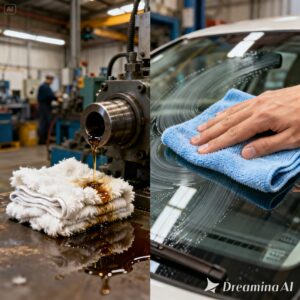
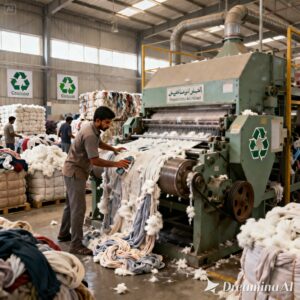
Wiping rag manufacturers produce wiping rags from textile waste such as hosiery, cotton jersey, fleece, woven fabric, or denim. They collect, sort, clean, and compress these materials into bales before supplying them to factories.
Furthermore, their absorbency, texture, and lint level vary depending on the fabric type. Hence, each category serves a specific industrial purpose.
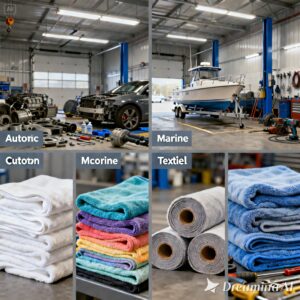
Decision Matrix: Choosing the Right Wiping Rag by Industry
We have created the following matrix to simplify the selection process across different sectors:
1. Automotive Industry (Workshops, Detailing, Lubrication Units)
| Requirement | Ideal Rag Type | Reason |
|---|---|---|
| Oil absorption | Hosiery / White Hosiery | High absorbency & lint-free finish |
| Polishing | Fleece Rags | Soft texture prevents scratches |
| Surface cleaning | White Cotton Rags | No dye transfer; clean finish |
| Heavy wiping | Denim / Woven Rags | Strong and durable for rough surfaces |
Thus, automotive units benefit from lint-free, soft, and durable rags that handle oil and grease effectively.
2. Marine Industry (Boats, Engine Rooms, Ports)
| Requirement | Ideal Rag Type | Reason |
|---|---|---|
| Saltwater wiping | Fleece Rags | High moisture absorption |
| Engine cleaning | Coloured Cotton Rags | Cost-effective for heavy dirt |
| Polishing metals | White Hosiery | Smooth and lint-free |
| Multi-surface cleaning | Mixed Rags | Versatile and economical |
Moreover, higher moisture environments require rags that can retain and release water efficiently.
3. Textile & Garment Industry
| Requirement | Ideal Rag Type | Reason |
|---|---|---|
| Machine cleaning | Coloured Rags | Affordable for frequent use |
| Oil/grease wiping | Hosiery Rags | Excellent absorbency |
| Dye room cleaning | Mixed Rags | Resistant to staining |
| Finishing & polishing | White Hosiery | No lint contamination |
Therefore, absorbent and economical grades are preferred in textile manufacturing.
4. Industrial Maintenance (Factories, Steel, Chemical Plants)
| Requirement | Ideal Rag Type | Reason |
|---|---|---|
| Heavy machinery cleaning | Denim / Woven Rags | Tough material for rough surfaces |
| Oil & chemical spills | Hosiery Rags | Strong absorbency |
| Daily cleanup | Coloured Cotton Rags | Economical for bulk use |
| Polishing valves/metals | White Hosiery or Fleece | Smooth finish with no lint |
Consequently, strong and absorbent rags are selected to handle tough industrial dirt.
5. Printing & Packaging Industry
| Requirement | Ideal Rag Type | Reason |
|---|---|---|
| Ink wiping | White Hosiery | No dye mixing |
| Machine rollers | Fleece Rags | High liquid retention |
| Surface cleaning | White Cotton | Clean finish |
| General wiping | Mixed Rags | Affordable for daily use |
Additionally, white rags are preferred because ink contamination needs to be avoided.
Summary of Rag Types & Uses
| Rag Type | Best For | Why |
|---|---|---|
| White Cotton Rags | Polishing, glass, printing, finishing | No dye transfer, lint-free |
| Coloured Rags | Heavy cleaning, machinery, grease | Cost-effective |
| Hosiery Rags | Oil absorption, automotive, textile | Soft + high absorbency |
| Fleece Rags | Polishing metals, detailing, marine | Very soft + moisture retention |
| Denim/Woven Rags | Heavy-duty cleaning | Strong and durable |
| Mixed Rags | General-purpose wiping | Economical for bulk use |
Conclusion
To summarize, the correct selection of wiping rags ensures improved cleaning efficiency, cost control, and longer equipment life. Each industry requires a specific rag type based on surface sensitivity, absorbency level, and the nature of contaminants.
Consequently, a structured decision matrix enables industries to make informed and practical choices for smoother operations.